 WORDROW Korean Idioms
 Sky and fields
Select a marker to zoom in and see related idioms. The number in each marker shows how many idioms are linked to that spot.
Handwriting books for this scene12 books
Where would you like to start?
Sky, Sun & Moon
31 idioms Korean words
31 idioms
 go missing from the accounts For quantities of goods and the like to be short or missing when accounts are calculated.
  2 meanings Polish or embellish Give something a glossy shine
  have no one appear For not a single person to appear.
  leave no trace To have no trace or sign remaining.
  Disappear from sight Hide one’s traces and cease appearing
  Be nowhere to be found Have vanished so completely that one cannot be found.
  do something absurdly out of place A reproachful expression for doing something inappropriate to the occasion.
  Daybreak begins For day to break and bright sunlight to begin shining
  Densely like stars Like stars densely studding the sky.
  see stars To become suddenly dazed and dizzy from a shock.
  Show one's worth Reveal one's ability or value.
  come to light For achievements, worth, or the like to become apparent.
  Recoil intensely Show extreme aversion
  3 meanings Know no bounds Fail to know one’s proper station
  the Thousand Character Classic A figurative expression for the Thousand Character Classic.
  Limp Figuratively, limp; the character suk in the Thousand Character Classic’s fourth phrase, jin-suk-yeol-jang, is associated by sound with the word for limping
  worlds apart A figurative expression for a great difference or distance between two things.
  Reach immense proportions Be very great, high, or abundant.
  leave it to fate To follow fate.
  2 meanings Live under the open sky Live and sleep outdoors
  2 meanings Tower high; have overwhelming momentum Rise very high.
  2 meanings be faint with exhaustion or shock To be severely weakened by excessive fatigue or grief.
  Become dizzy from weakness or shock Suddenly feel faint from exhausted strength or a great shock
  Whatever the hardship However great the difficulty.
  rain For rain to fall.
  Feel everything go dark Feel dizzy and dazed from a great shock
  Trust completely Place great expectations on something and rely on it completely.
  Do something utterly unexpected Figuratively, said when someone intends or does something wholly unexpected or astonishingly impossible
  Spend the whole day Spend the entire day.
  have many years pass For a great deal of time to pass.
  3 meanings be ungrounded An expression for a state detached from reality.
 No idioms at this spot match your search.
Weather
59 idioms Korean words
59 idioms
 The atmosphere is tense The atmosphere is extremely tense.
  flock together To gather in large numbers all at once.
  Chase vague fantasies Pursue something vague or fanciful.
  One misfortune upon another Repeated occurrence of misfortune
  Dampness develops Have dampness arise.
  Snow seems imminent Seem about to snow
  Long desperately for something Literally, await signs of rain during a great drought; yearn for something to happen
  Suffer from the heat Develop abnormal physical symptoms from summer heat
  Suffer from the heat Develop abnormal bodily symptoms from summer heat.
  buy someone’s summer heat An expression from the heat-selling custom on the fifteenth day of the first lunar month: answering when someone calls one’s name means taking on that person’s heat too and suffering from the summer heat.
  Pass one’s summer heat to another From the heat-selling custom on the fifteenth day of the first lunar month: call someone’s name and, when they answer, give them one’s heat so as to avoid heat illness in midsummer
  Disappear all at once Figuratively, describe everything suddenly disappearing.
  2 meanings suffer a hard frost or harsh blow To be exposed to a severe frost.
  Chase a vague fantasy Pursue something vague or fanciful
  Suffer an unforeseen disaster Suddenly suffer an unexpected calamity
  Suffer a sudden disaster Suffer an unexpected disaster suddenly.
  Incite someone Encourage someone to develop the desire to act.
  2 meanings get some fresh air or outside experience To walk or travel outdoors or elsewhere for a change of mood.
  Offer a wind-god rite To ward off storm damage, offer a wind-god rite with rice, vegetables, rice cakes, and the like from the first day of the second lunar month until the fifteenth or twentieth, praying to Grandmother Yeongdeung and her daughter-in-law
  2 meanings create a wave To influence many people socially.
  3 meanings Encourage foolishness; wander; think of romance Plan or encourage fanciful behavior.
  act frivolously To act frivolously or flightily.
  Lose vigor Lose previously flourishing vigor
  2 meanings Become spongy; develop trouble Of a radish or the like, lose moisture and become spongy through repeated freezing and thawing.
  words deserving divine punishment Absurd words deserving punishment from heaven.
  2 meanings Like lightning Extremely quickly
  strike like lightning An expression for striking very quickly or forcefully.
  2 meanings Receive harsh punishment or scolding Receive a severe punishment for very wicked acts
  2 meanings Suffer calamity or a severe scolding Have a great calamity occur.
  2 meanings melt away like spring snow A figurative expression describing something quickly wasting away and disappearing.
  2 meanings Like rain For arrows, bullets, or the like to fly in or fall in great numbers
  Carry rain-bearing dampness Contain damp air that can bring rain.
 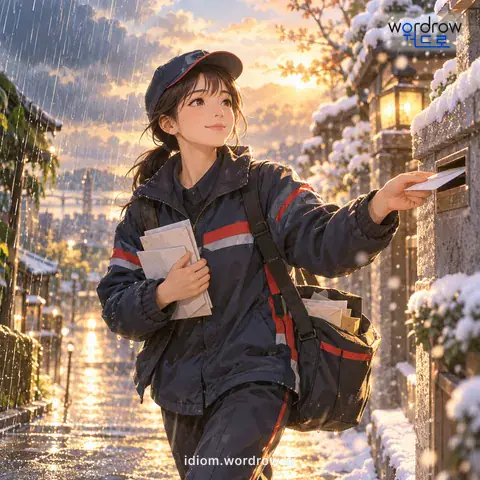 come rain or snow Always consistently, however difficult things become.
  a gleaming sharp blade A sharp sword flashing white like cold frost.
  have one’s hair turn white For the hair to turn white.
  Suffer a harsh blow Suffer major damage or a setback from authority, violent force, or the like
  Turn white-haired Have one's hair turn white.
  have white hair For the hair to turn white.
  2 meanings Frost rises; severity shows Have bundles of thin, long ice filaments form on the ground surface.
  2 meanings Form frost or have a fierce bearing For frost crystals to form
  remain shrouded in mystery For a fact or secret to remain undisclosed.
  Obscure the truth Use clever methods to hide a fact.
  Remain shrouded in mystery For a fact or secret to remain undisclosed
  Act foolishly Act frivolously and foolishly as though partly affected by a stroke.
  Thunderous applause Figuratively, very loud applause from many people.
  2 meanings Hail down For hailstones to pour down heavily
  Flood in the Rain Water season For heavy rains during the Rain Water solar term to cause flooding
  The weather clears Of previously cloudy weather, become clear.
  lose one’s life at execution or war To lose one’s life at an execution ground or on a battlefield.
  Walk through the dew Tread on dew fallen on the ground
  Die in execution or battle Lose one's life at an execution ground or on a battlefield.
  move with a surge of speed Figuratively, to gain strength and move very rapidly.
  Act coldly Reveal a cold, indifferent attitude.
  have a chill enter the mood For one’s mind or the atmosphere to become harsh and forbidding.
  dream of worldly success A figurative expression for the dream of rising in the world.
  Lofty ambitions Figuratively, a great hope of attaining distinction and success
  Be fleeting as dew For life or the like to be transient
  Flood on Chilseok For rain on Chilseok, the seventh day of the seventh lunar month, to cause flooding
  Ambition for greatness Figuratively, the hope to rise in the world and accomplish great things.
 No idioms at this spot match your search.
Time & Seasons
64 idioms Korean words
64 idioms
 stay up through Gyeongsin night To stay awake all night on a Gyeongsin day in the twelfth lunar month.
  bring seasonal work forward An expression for doing the work of a particular season earlier and more quickly.
  Have a troubled past Have dark or complicated experiences in one’s past
  Stay up all night for no purpose Stay awake all night needlessly and fruitlessly
  Choose an auspicious day Choose a lucky day for marriage, a funeral, moving, or the like.
  2 meanings set a date To set the date of a wedding.
  2 meanings Set a date Set a wedding date
  pass the day To spend a day doing something.
  Be too late to hope Have no prospect because the time for accomplishing the task has passed.
  Every single day On every day without exception
  Lose track of day and night Lose awareness of time passing while doing something
  Work day and night Continue a task without resting.
  day and night Always, at all times.
  Day and night Always, continually
  Keep putting off repayment Fail to give something on the promised date and keep postponing it day after day
  have the impure month pass For the month considered ritually impure because someone died to pass.
  Reach the due month Reach the month in which one is due to give birth
  Hold a first-birthday choosing rite Celebrate a child’s first birthday by setting out various foods and objects and letting the child pick freely
  2 meanings have a long interval or distance For an interval of time to be long.
  work without regard to day or night To continue an undertaking regardless of the time.
  Work around the clock Continue an undertaking without distinguishing day from night
  No matter how late Emphatically express determination to finish a matter no matter how late it takes.
  even if it takes ten nights An emphatic expression for determination to finish something no matter how long it takes.
  Be utterly uninformed Someone ignorant of worldly affairs who knows nothing.
  Be conceited Another expression for being conceited or looking down on others. In the byeongja year, 1876, the thirteenth year of King Gojong's reign in Joseon, severe drought dried up reservoirs, called geon-bangjuk, “dry reservoirs”; the expression arose because this sounded like geonbangjida, “be conceited.”
  2 meanings Be affected by spring Lose appetite or become listless and thin in spring
  Race against time Hurry urgently, saving even the briefest time.
  make every second count To use time effectively without wasting it.
  Every few days With extremely frequent recurrence
  the long spring days The extremely long, tedious days of the third and fourth lunar months.
  A bride of less than three days A newlywed woman married for fewer than three days.
  A person of extraordinary longevity Figuratively, a long-lived person, from the story that Dongfang Shuo of China's Former Han lived through three thousand jiazi years and reached 180,000 years of age.
  give workers a meal break To give workers time to eat at a workplace.
  only find acceptance at year’s end To be so disliked by everyone that one can only assert oneself at the year’s end.
  Have one’s day Encounter favorable times and flourish
  Enjoy a profitable season Meet favorable timing and earn money well.
  have time drag For time to seem not to pass.
  Be in immediate danger Be extremely endangered
  Lose track of time Fail to notice how time has passed because things move busily or one is absorbed in a task
  happen at any hour To be unrestricted by time.
  At all hours Frequently, regardless of the time.
  set a time limit To impose a time limit.
  Be close to death Be nearly dead
  Regardless of the day There is no need to distinguish or consider dates.
  regardless of when Without selecting or considering particular days.
  Change from day to day Change extremely quickly
  Yesterday already seems long ago Change so quickly that even a short interval brings great differences.
  Be different overnight Become different within a day and no longer be the same
  once upon a time A very long time ago.
  Be sparse For things to be spaced sparsely
  Be slow and drawn out Describe actions or words as slow or stretched out.
  2 meanings Calculate the sexagenary cycle or fortune Use a person’s age to calculate their birth year in the sexagenary cycle
  Up to this very day Until the present day
  Be urgently busy Be extremely busy.
  Promise to marry Pledge to marry
  Choose according to season Distinguish or choose things by considering the season
  change by the day For change in something to be conspicuous.
  Almost every day Frequently, nearly every day
  3 meanings Each day is precious, arduous, or different Have time be so important that its passing is regrettable.
  dozens of times a day Very frequently.
  pass noon For the sun to pass lunchtime.
  Be urgently pressing Be extremely urgent
  Have no time to spare Be so busy that every moment counts.
  3 meanings have every moment matter For time to be precious so that its passing is regretted.
 No idioms at this spot match your search.
Land, Mountains & Rocks
40 idioms Korean words
40 idioms
 2 meanings Drive a mine tunnel; dig a placer ditch Excavate a mine tunnel along a vein of ore.
  Make a pleasing couple Feel pleasure at the sight of a man and woman who look well together
  a person or thing of excellence A figurative expression for an outstanding person or object.
  croak A coarse expression for to die.
  Kill someone A vulgar expression for “to kill”
  Resolve a rift Eliminate conflict.
 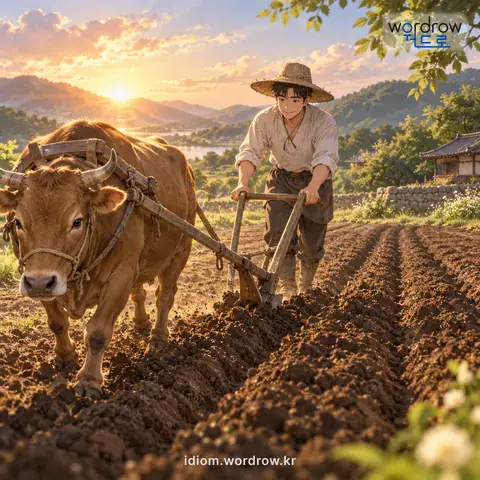 Plow a third time Plow a field for the third time
  Saw a log lengthwise Saw a log lengthwise to make a last.
  have a deepening rift For a relationship to worsen or grow distant.
  2 meanings cast blame or resign a game To criticize another person’s wrongdoing.
  Quarry stone Produce building stone from rock
 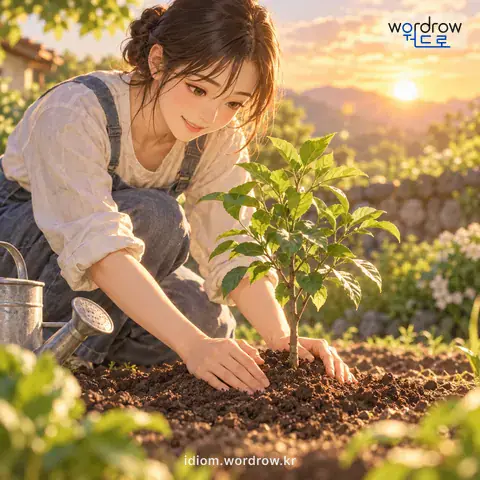 2 meanings Take root and thrive For a transplanted plant to root in new soil and become vigorous
  Fall into disgrace Of honor, authority, or the like, be damaged beyond easy recovery.
  be infuriatingly unjust An expression for extreme resentment and anguish.
 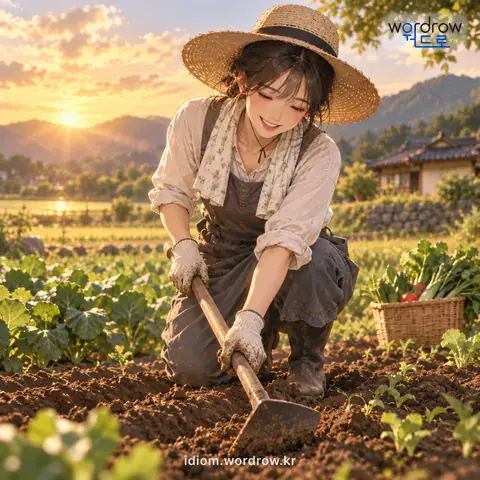 Farm the land Vulgarly, engage in farming
  With a deep, heavy sigh Extremely deeply and heavily, when sighing
  Excavate the coffin bed Cut away the soil in a grave pit to make the place where the coffin will rest.
  Make a grave Choose a grave site and bury the body when someone dies
  Dig one's own grave Head toward one's own destruction.
  dig one’s own grave To bring about one’s own ruin.
  Mine downward In mining, excavate downward into the earth.
  Mine downward In mining, dig downward into the ground
  Be driven to the brink Come to face a dangerous situation
  Face a crisis Come to face a dangerous situation.
  Be in wholly unfamiliar surroundings Be away from home, with everything very unfamiliar and awkward.
  2 meanings take to the mountains To hide in the mountains to engage in underground resistance or guerrilla warfare.
  Strip a mountain of trees Cut down all the trees on a mountain
  Discover a new ore vein Discover another ore vein while mining an existing one.
  strike a profitable new vein To discover another ore vein while mining one and make a great profit.
  A terrifying person or thing Figuratively, an extremely frightening person or thing
  Follow the lower ore vein Mine along the ore vein where rich ore reappears below a break.
  have a drink-reddened face A teasing expression for someone whose face has turned red from drinking.
  The ore vein improves In a mine, have the ore vein improve progressively compared with the area previously excavated.
  drive trouble beyond one’s boundary To move something likely to cause an accident to another area to avoid responsibility, or to drive a fierce animal into another area.
  With a thunderous roar Figuratively, describe a tumultuous sound caused by a typhoon, cannon fire, or the like
  Have eyes round with shock Figuratively, describe eyes rounded through surprise.
  step into a hole To misstep, thinking there is solid ground underfoot.
  2 meanings Step into a pit or make a wrong calculation Misstep and fall into a pit
  Have one's hopes fail Have what one hoped for end in failure.
  Take root in new soil Of a transplanted plant, take root in new soil and become vigorous.
 No idioms at this spot match your search.
Rivers & Water
41 idioms Korean words
41 idioms
 watch with indifference The manner of standing by indifferently, considering something unrelated to oneself.
  Watch unconcernedly Stand by indifferently, considering the matter unrelated to oneself.
  Disperse foam Remove foam by exposing it to cold air or the like
  Fade away helplessly Describes something once flourishing disappearing or dwindling helplessly.
  Have surface water collect Have watery liquid float and move on the surface of a liquid
  embroider winding water To embroider water flowing in winding curves.
  Be caught in the fallout Have misfortune spread to oneself
  gain rapid momentum For work, discussion, or the like to proceed quickly.
  Be left forlorn and alone Figuratively, a forlorn state of being separated from a group or isolated alone
  2 meanings Buckwheat blooms or waves foam For buckwheat flowers to bloom
  be beyond remedy For a situation to have ended so that no action can be taken.
  be in a bubbling uproar For many people to become highly agitated.
  Be in one's element Describe escaping hardship and finding a setting in which one can flourish.
  fall suddenly silent A figurative expression for many people suddenly becoming quiet or solemn.
  Babble indiscriminately Figuratively, talk indiscriminately whatever comes to one’s mouth, whether sensible or not
  Spend freely Use goods wastefully or squander money freely.
  Fail to mix with others A relationship in which people cannot blend and remain detached.
  2 meanings Be sleek and graceful; move deftly Figuratively, a person with a very sleek, attractive figure, like a swallow taking flight after skimming the water.
  2 meanings pour down or pour out words For rain to fall extremely heavily.
  ride the current To conduct oneself in keeping with contemporary trends or circumstances.
  Oil and water A relationship in which people fail to mix and remain detached
  Be incompatible A mutually incompatible or opposed state, or things in such a state.
  Treat someone as a pushover Regard someone as insignificant or easy to handle
  Stop at nothing Act obstinately without considering danger or difficulty
  be utterly bland To have no flavor and be bland.
  Look like a drowned rat Figuratively, the disheveled appearance of being thoroughly drenched
  fall suddenly silent A figurative expression for many people suddenly becoming quiet or solemn.
 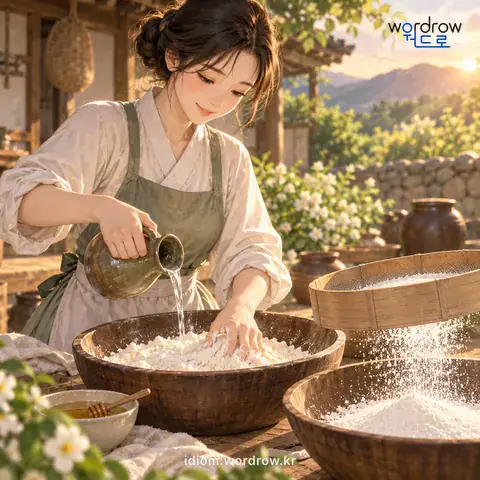 moisten and resift rice-cake flour To sprinkle honey water or cold water on rice-cake flour, rub it by hand, and sift it again.
  Take healing spring water Visit a medicinal spring to drink its water or wash one’s body to prevent or cure illness
  Bring water into a place Bring water in so that it collects or is contained somewhere.
  lose one’s vitality For a person to lose vitality through exhaustion or loss of purpose.
  Develop blisters Have blisters form on the skin
  Be steeped in an influence Be so deeply influenced that it permeates one's life.
  Act without any judgment Act recklessly without distinguishing right and wrong or examining matters
  Be as vast or deep as the sea Mean that something is extremely vast or deep
 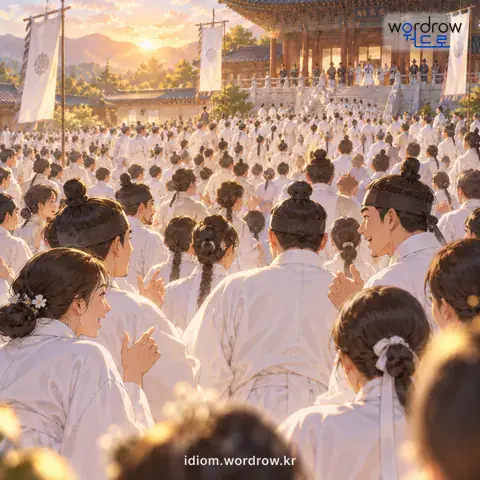 A vast crowd mills about For an innumerable crowd in white clothes to gather and murmur
  the tip of the iceberg A figurative expression meaning that most is hidden and what is visible outside is only a tiny portion.
  Feel as though treading thin ice Feel deeply anxious because things are precarious
  With extreme caution Very carefully through fear.
  Take healing spring water Visit a medicinal spring to drink its water or wash one’s body to prevent or cure illness
  Floodwaters sweep through For heavy rain to make a river or stream overflow and sweep through fields
 No idioms at this spot match your search.
Fire
21 idioms Korean words
21 idioms
 die helplessly A figurative expression for dying as though fading away helplessly.
  Exchange gunfire Aim at one another and exchange gunfire
  2 meanings Light a beacon; pioneer a cause Light a beacon fire and raise it high.
  pioneer an undertaking Figuratively, to take the lead in starting an undertaking or movement as a pioneer.
  Strike a light Place tinder on flint and strike it with a fire steel to make a fire
  2 meanings be fiercely competitive or visibly furious For competition to be intense.
  2 meanings have urgent trouble descend For a matter to become extremely urgent.
  Be caught in the fallout Have disaster or harm extend to oneself.
  Handle an urgent matter Deal with urgent business.
  Light an explosive fuse In mining, light a fuse to detonate explosives.
  be shot To be hit by a bullet.
  Suffer an insult or disaster Be subjected to great humiliation by another or suffer a disaster
  Be plain as day Of a future event, be unmistakably clear.
  2 meanings open fire or burn with intensity For bullets to come out of a gun muzzle.
  cause someone great harm To cause someone severe trouble or harm.
  2 meanings Flare with anger or see sparks Have one’s emotions intensify after an unexpectedly infuriating experience
  Rapidly and vigorously For a situation to be rapid and vigorous
  Flare up with anger Have feelings become intense after unexpectedly experiencing something infuriating.
  a spreading wildfire A figurative expression for a force spreading with terrifying momentum, referring to a fire spreading rapidly across an open plain.
  Burn with fury Find something so offensive or angering that one seems to give off heat
  Smoke at a temple Vulgarly, smoke tobacco at a Buddhist temple
 No idioms at this spot match your search.
Trees & Plants
60 idioms Korean words
60 idioms
 Feel uneasy over a favor received Feel uneasy and troubled about something received or eaten from another person.
  Be barbed Have an intent to attack or express complaints and dissatisfaction
  Be sharply hostile An emphatic expression for having hostile intentions or grievances.
  have malice in one’s words For words to contain malice.
  Be sharp and stubborn Be fierce-tempered and obstinate
  branch out For new offshoots to arise from a single source.
  Leave a bitter aftertaste A bitter, astringent aftertaste
  A child's soft little hands Figuratively, a young child's tender, plump hands.
  a child’s soft, chubby hands A figurative expression for a young child’s delicate, plump hands.
  2 meanings Become hollow inside For the inside of a living tree to decay naturally with age and become hollow
  Tap something upside down Set an object down upside down with a tap.
  lay the groundwork To establish the foundation for future work.
  Align the bases Set the lower ends or bases in an orderly alignment
 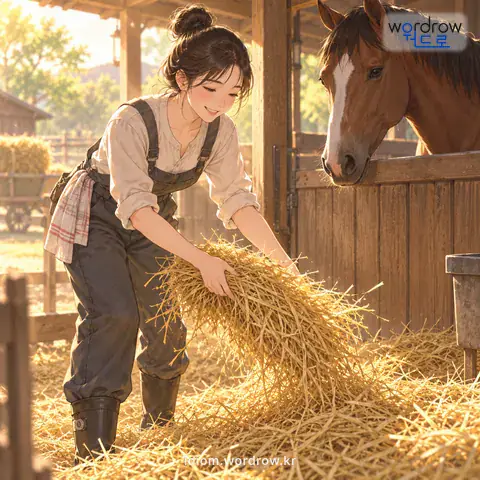 2 meanings Lay animal bedding; set a fish lure Spread straw or dry grass in a cattle shed, stable, chicken coop, or the like.
  Paint orchids Paint orchids in East Asian painting
  Paint orchids Paint orchids in East Asian painting
  Beans come into bloom For soybeans, adzuki beans, or the like to bloom
 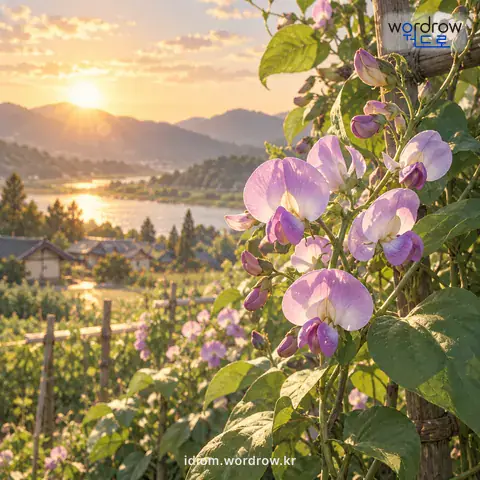 Cowpeas flower Of cowpeas, blossom. 2 meanings Buckwheat blooms or waves foam For buckwheat flowers to bloom
  a twisted, spiteful disposition An expression for a disposition as twisted as a quince tree, spiteful and uncooperative.
  beat mercilessly An expression describing beating someone indiscriminately.
  Begin clear-cutting Begin cutting all the trees in a logging work area at once
  Clear-cut trees Fell densely standing trees all at once.
  Keep springing up Figuratively, the manner of worries, fantasies, or the like arising continually, one after another
  be reduced to a wasteland For a house site or the like to become ruins with only vacant ground remaining.
 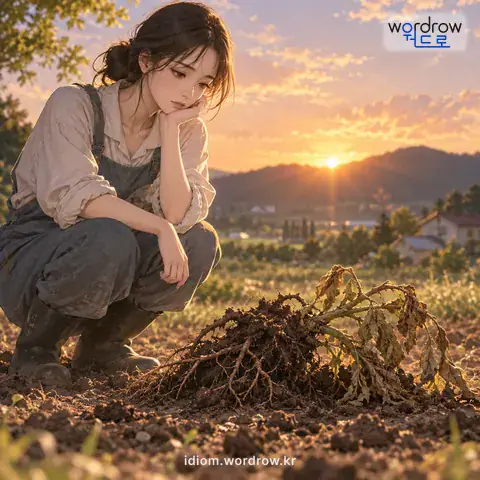 Be eradicated Have the source from which something can arise and grow eliminated.
  Be deeply rooted Have an origin going far back.
  be utterly exhausted at the source For even the source to be gone, leaving nothing at all.
  Root out Eliminate the source from which something can arise and grow
  Shake like a leaf Figuratively, describe the body shaking intensely.
  Stand densely like hemp stalks Figuratively, the manner of straight, long objects standing densely together
  Fall in masses Figuratively, describe falling down in great numbers.
  dismiss brusquely A figurative expression for dismissing a statement or opinion without any consideration.
  Grow an inner stalk For a leafy vegetable’s inner stalk to grow progressively larger
  form a dense forest For many things to stand densely together.
  Show no sign at all Show no trace whatsoever
  2 meanings Nip something in the bud; notice a sign Block something new from the beginning or eliminate it entirely.
  show no promise To show no possibility or hope of doing well from the outset.
  Disappear entirely For an entire kind of thing to vanish
  have substance For words or actions to be coherent and substantial.
  Leave absolutely nothing Leave nothing at all.
  not get through at all For a proposed method or opinion not to be accepted.
  Without leaving a trace Entirely, leaving nothing behind
  Wipe out completely Eliminate everything without leaving anything.
  plant seeds to germinate To plant seeds in the ground and make them sprout.
 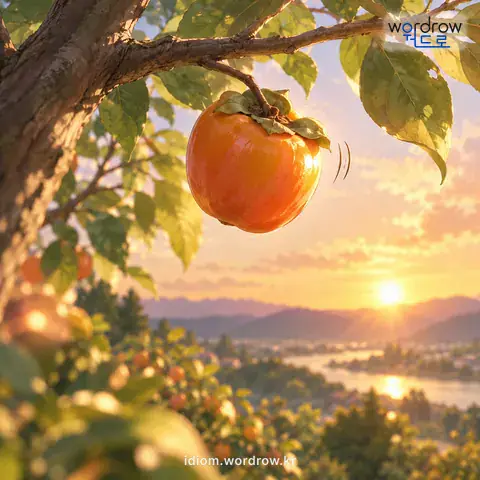 Ripe fruit falls or is ready to fall Of ripe fruit, fall from the tree or be about to fall.
  weep with tears falling in drops Colloquially, to cry with tears dropping down.
  Coax someone into something Gently cajole and entice.
  Bear fruit For the results of one’s efforts to appear
  cower in fear To be unable to act confidently because of fear.
  Harbor a grievance Have an unpleasant feeling in one’s heart
  develop a lacquer rash For lacquer exposure to make the skin sore and erupt in rashes.
  nip a force in the bud To break a force or strength just beginning to grow.
  Be stifled at the outset Have growing strength, influence, or the like checked
 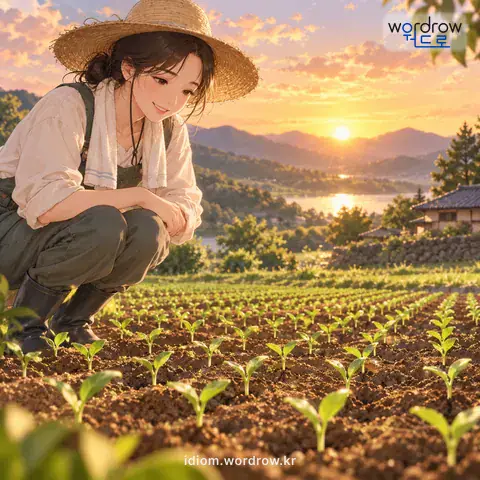 Seeds sprout evenly For seeds sown in a field to sprout evenly
  Exhaust one's strength Use up all strength or energy and make someone exhausted.
  be drained To lose further motivation through disappointment or weariness, or to become exhausted after using all one’s strength.
 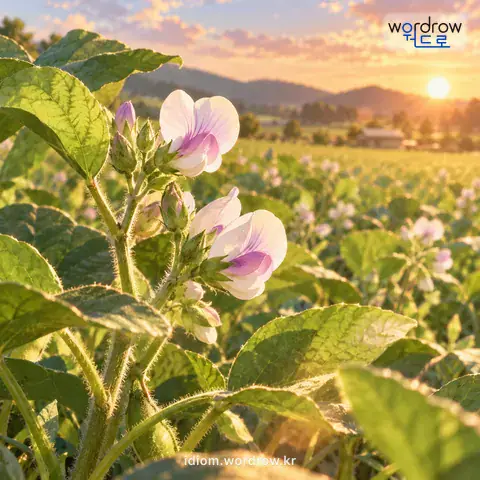 Soybeans bloom For soybean flowers to bloom
 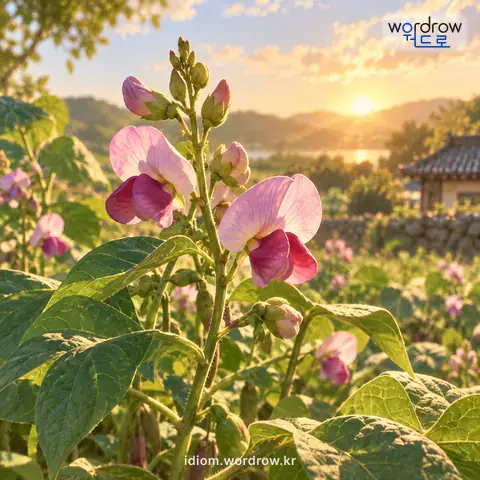 have red-bean plants flower For red-bean flowers to bloom.
  Act innocent while hiding one's ways Feign innocence as though one is not really like that.
 No idioms at this spot match your search.
Farming
28 idioms Korean words
28 idioms
 show the effects of fertilizer For the effects of fertilizer to become apparent.
  Have evenly emerged ears of grain Of rice or barley, have ears emerge evenly in neat alignment.
  turn over stubble To plow the ground and overturn crop stubble.
  Replant harvested ground Turn over harvested ground and plant grain anew
  Suffer from repeated cropping Of grain, grow poorly because the same kind has been planted repeatedly in one field.
  Have great stores of grain Store a large amount of grain.
  A destitute death away from home Die miserably away from home, penniless and without support, using a paddy ridge as one’s pillow
  die destitute To become penniless and die miserably.
  plant an intercrop To plant beans, red beans, or the like in the rows of a field planted with another crop.
  2 meanings eat together as a group For several people to sit in a circle and eat together.
  Follow someone everywhere Have a tendency to follow someone closely everywhere.
  sow a rice seedbed To prepare a rice seedbed and sow seeds.
  Enter the milky grain stage Of grain, develop soft, milky kernels.
 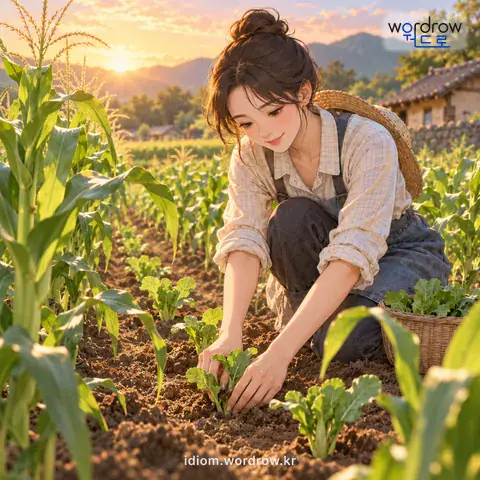 Intercrop Plant another crop between rows of grain, vegetables, or other crops
  Earth up a plant Cover a plant's roots with soil.
  long, thick hair Long hair with great thickness.
 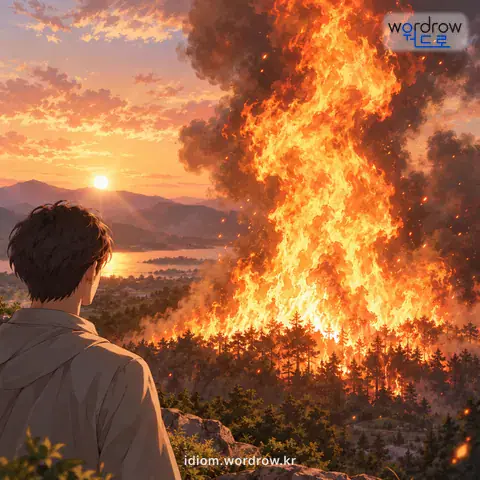 Towering flames Flames rising upward and burning fiercely
  Lease land to a tenant farmer Lease land in return for rent from a tenant farmer.
 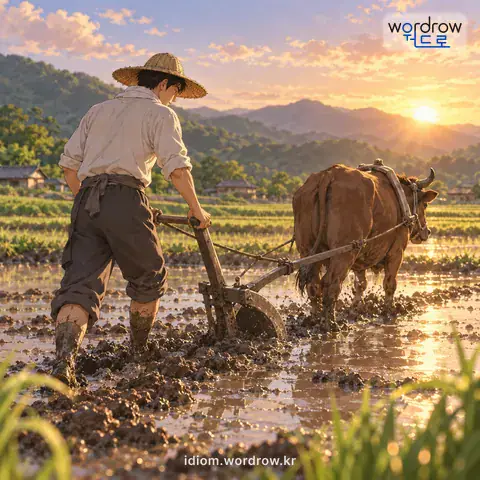 plow a paddy a second time To plow the same rice paddy for the second time.
  Plant cucurbit seeds Sow seeds of cucumbers, melons, watermelons, pumpkins, or similar field-grown crops
  Sow millet between cereal rows In early spring, dig with a hoe between rows planted with barley or wheat and sow millet sparsely.
  intercrop beans To use a hoe to plant beans sparsely between rows of barley, wheat, millet, or the like in early spring.
  Thresh forcefully Thresh by beating extremely hard
  step gingerly A figurative expression for moving one’s feet cautiously.
  Interplant red beans In early spring, hoe between rows of barley or wheat and plant red beans sparsely.
  Finish the weeding In a farming household, finish weeding around the seventh lunar month.
  Include the expected rice crop in a sale When selling a rice paddy, include the expected rice crop or its cultivation rights in the sale terms.
  Grain is struck by yellowing disease Of barley or wheat, suffer yellowing disease and rot.
 No idioms at this spot match your search.