 WORDROW Korean Idioms
 Home and courtyard
Select a marker to zoom in and see related idioms. The number in each marker shows how many idioms are linked to that spot.
Handwriting books for this scene5 books
Where would you like to start?
Door & Threshold
20 idioms Korean words
20 idioms
 Cut a groove Cut grooves in frames for papered sliding doors, removable plank doors, or the like.
  Graduate from school Graduate from school.
  Work the door Slang: guard the entrance to a theater, entertainment venue, or the like.
  2 meanings open one’s doors To establish external relations in fields such as politics, economics, or culture.
  come and go secretly To come and go secretly without others knowing.
  close down To stop operating a business and shut it down.
  4 meanings Open up Begin business or similar operations
  Come and go constantly Come and go very frequently.
  come and go freely To enter and leave a place very easily and frequently.
  Make more accessible Make something easy and comfortable to approach
  Emerge from a condition Escape an environment or state.
  raise the barrier to entry To make access difficult.
  Be difficult to approach Be difficult to enter or deal with
  Come and go constantly Visit extremely frequently.
  bar one’s heart To keep one’s thoughts firmly concealed rather than reveal them to others.
  open the three gates To open the three gates of a palace or government office.
  Open the central gate for a distinguished guest Formerly, at a government office with three gates, specially open the central gate to welcome an important guest other than the office's high official.
  A prison without bars Figuratively, a place where control and surveillance leave one unable to move freely, much like a prison.
  Open the main gate Open the main gate when a person of high rank enters or leaves.
  Build an arch Make something such as a doorway in an arch shape.
 No idioms at this spot match your search.
Wall & Fence
8 idioms Korean words
8 idioms
 Commit theft Steal
  2 meanings Cut off contact End a previously friendly relationship.
  hit a wall To be blocked by an obstacle.
  Cut off a relationship End a previously friendly relationship.
  2 meanings Brace against or face a wall Place both hands against a wall
  Fill a gap in masonry Fill an opening in a wall or similar structure with mud or the like
  Leave one's limited world Emerge from a relatively narrow, limited sphere of life.
  Be near death in old age Be old and ill, almost at death.
 No idioms at this spot match your search.
Roof & Eaves
10 idioms 10 idioms
 saw a joint To saw wood to make joints, such as a four-way joint in a pillar or a crosspiece joint in a lintel.
  Cut a forked joint Cut the forked sections of a pillar-head joint or the split tenon of a lintel
 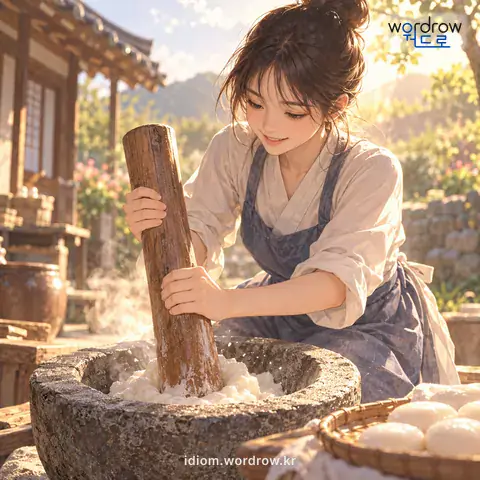 Build a traditional clay ceiling Make a traditional ceiling of thick crossbeams, woven laths, and a thick coating of clay.
  fly into a rage To leap about in anger.
  shape upturned rafter tips To carve the rafters by the eaves so that they appear to curve upward.
  Fit together perfectly For words or reasoning to be perfectly consistent without any gaps
  lay roof lathing To weave and lay roof laths.
 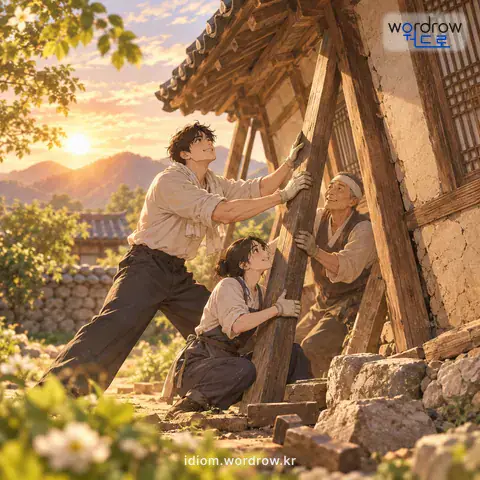 Straighten a leaning structure Straighten and erect a leaning house or the like.
  Carve paired concave grooves Slightly bevel the edges of a pillar, wooden vessel, or the like and carve concave grooves.
  Know no ceiling Have no discernible limit
 No idioms at this spot match your search.
Inside the Room
18 idioms Korean words
18 idioms
 Become a wife or concubine A humble expression used by a woman for becoming a wife or concubine.
  lie around in bed A coarse expression for lying in a room with a heated floor.
  Be cornered Fall into a difficult or awkward position.
  2 meanings have shortcomings or inconsistencies To have gaps or shortcomings in handling matters.
  first from the bottom A teasing expression for last place.
  2 meanings Scrape by or remain at the bottom Have difficulty making a living
  Be at rock bottom Have a wretchedly low degree or standard
  2 meanings exhaust one’s resources or see something through For all one’s capital to disappear.
 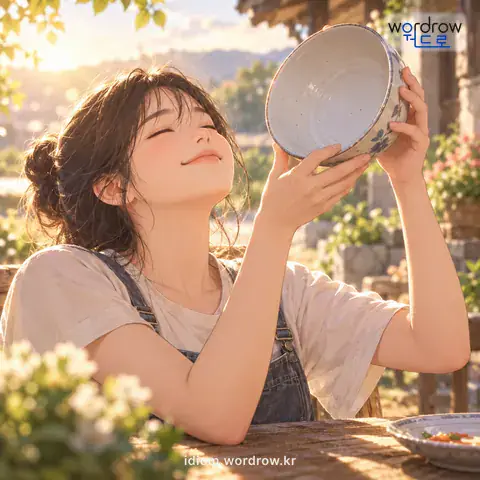 Empty completely Use up a certain quantity without leaving anything.
  2 meanings Run out; reveal one's identity Be consumed entirely and disappear.
 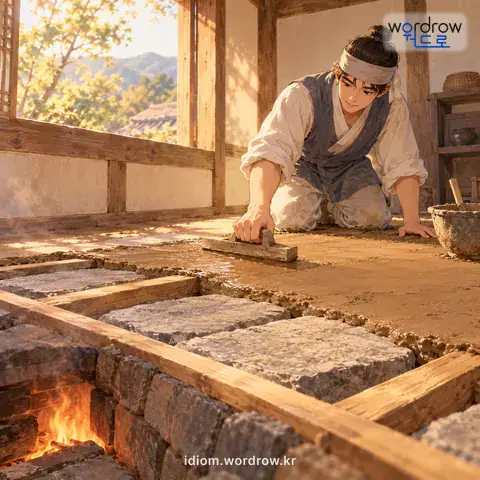 Build an ondol floor Construct a room floor by cutting heating flues, laying floor stones, and applying earth and finishing plaster
  have a gathering run long For a gathering or activity already begun to continue for a long time.
  show tangible results For the results of work to become clearly visible.
  3 meanings Become established For something awkward to become familiar
  2 meanings Establish oneself; take root in one's mind Occupy a certain position or space.
  Spring to one’s feet Rise forcefully and vigorously
  Put on makeup For a woman to apply makeup to her face
  Hold a wedding Conduct a wedding ceremony
 No idioms at this spot match your search.
Bedding
10 idioms Korean words
10 idioms
 Lay out bedding A term formerly used in the royal court for laying out bedding
  Dispatch something efficiently Finish an undertaking briskly and decisively
  Provide a chance to perform Give or prepare an opportunity to do as one wishes
  Sleep or live without worry Sleep soundly in peace of mind or live carefree.
  Lay out bedding Spread out bedding and prepare to sleep.
  Bravado in private Express pretentious boldness where others cannot see, as though spreading one's limbs inside a blanket.
  2 meanings Get up to leave; recover from illness Move from where one is to go elsewhere.
  recover from illness To recover from an illness.
  Go to bed Lie down in one’s bedding to sleep
  Be bedridden Lie down ill
 No idioms at this spot match your search.
Clothes & Hats
35 idioms Korean words
35 idioms
 Leave office A vulgar expression for giving up an official post
  gain high office A colloquial expression for attaining an official post or high position.
  Install someone in high office Slang: make someone attain an official post or high position.
  Dump one’s boyfriend Vulgarly, for a woman to unilaterally break up with the man she has been dating
  Leave military service Be discharged from the military
  Join the military Enlist in the military.
  Use a respectable guise Display a plausible, respectable label while one's inner nature or true substance is otherwise.
  Be excited Figuratively, become excited; a pun on sin, meaning both a shoe and the excitement in “get excited,” since nopari are shoes
  Filthy old clothes Figuratively, shabby, dirty old clothes.
  Submit when outmatched Figuratively, submit because one lacks sufficient strength
  exhaust one’s capital To use up all one’s capital and become ruined.
  Give away absolutely everything Hand over everything one has, even things one could not possibly give up or yield.
  an angel in white An idealized expression for a nurse.
  Finish the first mourning year Complete the first year in which mourning clothes must be worn under the prescribed mourning system
  Wear mourning clothes Wear the mourning clothes prescribed for the first year under mourning regulations.
  Saddle someone with loss or blame Cause a loss or impose responsibility on someone
  Act secretly with one’s hands For a hand movement or action to occur secretly without others seeing
  Take an active role Adopt a very active attitude toward something.
  Take an active role Adopt a very active attitude toward something.
  have nothing to one’s name To possess nothing.
  throw in the towel In boxing, for the manager of a fighter who cannot continue to request a technical knockout.
  Be packed tightly together Figuratively, the manner of people sitting densely packed in a room
  Rush to greet someone The manner of acting in a frantic, distracted rush to greet a welcome person
  2 meanings Be broad in tolerance or interests Be exceptionally able to stomach things
  2 meanings Be meddlesome Have a tendency to interfere excessively and needlessly in everything
  Straighten oneself in reverence With a reverent heart, arrange one’s clothes and correct one’s posture
  Be meddlesome Sarcastically, meddle and interfere needlessly in others’ affairs
  Meddle unnecessarily Sarcastically, interfere and meddle uselessly in others' affairs.
  Roll up one's sleeves Get ready to jump into a task and work actively.
  2 meanings roll up one’s sleeves To prepare to plunge into a task and work actively.
  2 meanings loosen one’s belt To gain room for comfort in one’s living circumstances.
  Steel oneself for a task Approach work with renewed determination and firm resolve to accomplish one’s intended aim
  3 meanings Tighten one's belt Live frugally.
  relax in relief To feel reassured, relax tension, and set one’s mind at ease.
  Discard without regret after use Discard without regret after making useful use of something.
 No idioms at this spot match your search.
Needlework
14 idioms Korean words
14 idioms
 Cross into an X Place long objects across one another in an X shape.
  Tattoo with inked thread Prick the skin with a needle threaded with inked thread and put ink into the flesh to make a tattoo or the like.
  Come and go rapidly Figuratively, go in and out rapidly and frequently.
  Come and go rapidly Figuratively, visit rapidly and frequently.
  attain an enviable position To occupy an excellent and rewarding position or place.
  Dress up something insubstantial Make something beautiful outside though worthless within
  topstitch To topstitch sewn, lined clothes, padded floor mats, cushions, or the like.
  Form a beautiful pattern Form a beautiful scene as though stitched in colored thread
  Over and over relentlessly Figuratively, pester persistently or repeat words at length
  Be arrogant and obstinate Figuratively, be arrogant and stubborn.
  Cast on stitches In knitting, form loops with netting or knitting yarn.
  pick up stitches In knitting, to catch edge stitches of a cuff, hem, or the like with a needle.
  2 meanings be loose or lack firmness For a fastening or joint to be slightly undone and loose.
  Be mentally sluggish Be mentally unclear, dull, or slow
 No idioms at this spot match your search.
Yard & Well
16 idioms Korean words
16 idioms
 apply a second coat of thick starch To apply thick starch over a surface already starched.
  become a wife or concubine Humbly, for a woman to become a wife or concubine.
  Keep parading a trivial achievement The manner of repeatedly bringing up and boasting about something insignificant
  2 meanings Suffer humiliation; take the blame unfairly Suffer disgrace that seriously diminishes one's dignity.
  Marry at the bride’s home For the groom to go to the bride’s home and hold the wedding rite
  hold one’s own against someone To act as a counterpart and stand up to someone.
  use the toilet Euphemistically, to go to the privy or relieve oneself.
  a crowd dressed in white An expression describing a very large gathering of people dressed in white.
  wellside gossiping A figurative expression for enjoying gossip while drawing water or washing clothes at a communal well or the like.
  gossip by the well Stories or rumors about the world exchanged by women while drawing water or washing clothes at a well.
  build an underground storage pit To make an underground storage pit.
  make lye To place ash from bean pods, fresh greens, or the like in a steamer and pour water over it so that lye runs out through the holes.
  Be stiff with starch For fabric to become stiff after being starched
  Lose stiffness Lose starchiness and cease to be stiff.
  Become homeless Set up one's household outdoors for lack of a home.
  Drive someone into a dead end Make someone fall into a hopeless predicament with no way out
 No idioms at this spot match your search.