 WORDROW Korean Idioms
 Idioms under “ㅅ” — 500 idioms
Browse idioms by the initial consonant of the first Korean syllable, in Hangul order. On this site, ㄲ, ㄸ, ㅃ, ㅆ, and ㅉ are grouped under ㄱ, ㄷ, ㅂ, ㅅ, and ㅈ, respectively.
 Shared · 2 get something without effort A disparaging expression for accomplishing a task or taking possession of something without effort.
  Even in a lifetime Even after a very long time passes.
  2 meanings Bring disaster; be absurdly cheap Have disaster arise because of an object.
  begin with an introduction To begin a speech or text before entering the main subject.
  a gleaming sharp blade A sharp sword flashing white like cold frost.
  Shared · 3 have one’s hair turn white For the hair to turn white.
  Suffer a harsh blow Suffer major damage or a setback from authority, violent force, or the like
  Shared · 3 Turn white-haired Have one's hair turn white.
  Shared · 3 have white hair For the hair to turn white.
  2 meanings Frost rises; severity shows Have bundles of thin, long ice filaments form on the ground surface.
  2 meanings Form frost or have a fierce bearing For frost crystals to form
  Mark the beginning For an undertaking to begin
  find someone a husband To cause someone to obtain a husband.
  Shared · 2 Have formidable power Have very great authority or momentum.
  Shared · 2 Wield formidable power Have exceedingly strong power or force
  Shared · 2 Do something utterly unexpected Figuratively, said when someone intends or does something wholly unexpected or astonishingly impossible
  Earn a living through manual labor Make a living through rough manual labor
  Something flimsy and badly made Figuratively, something extremely flimsy or poorly constructed.
  Give advance notice Inform in advance.
  give workers a meal break To give workers time to eat at a workplace.
  2 meanings Interfere ineffectually Interfere clumsily or ineffectually
  Shared · 2 Deliver an ineffectual blow Deliver an insufficiently decisive blow.
  receive an ineffectual blow To receive an inadequate or ineffectual blow.
  Shared · 2 Land an ineffectual blow Deliver an inadequate blow
  Make the first move Act toward another person before they act
  Shared · 3 Make the first move Begin before someone else.
  2 meanings strike or act first To strike someone first.
  2 meanings Shared · 3 Act first Begin before others
  Shared · 3 Strike first Begin before someone else.
  Establish connections Form a relationship with a person or group
  2 meanings Have delicate features; be petty and meticulous Have a frail, delicate appearance.
  2 meanings be robust or broad-minded To have large, sturdy features or build.
  Lose one’s place Lose the basis for one’s existence
  Have no place to stand Have no basis for existence.
  grovel To be cowed before someone, unable to act freely, and only obey.
  Assert authority Make a command or the like take effect
  An order takes effect Of an order or the like, become effective.
  Anger subsides Have unpleasant feelings caused by offense to one's temperament subside.
  Be narrow-minded and impatient Have little generosity and a quick temper
  Feel satisfied Consider something sufficient and satisfying
  Swear by one's name Swear never to do something again or guarantee something.
  Be furious Feel intense anger surge up.
 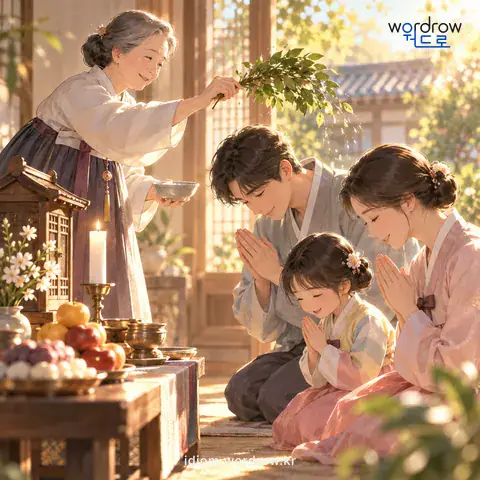 Install the household guardian Perform a rite to install Seongju as the household's guardian spirit.
  Pester persistently Repeatedly behave in an extremely bothersome way
  Shared · 2 pester someone relentlessly To annoy someone repeatedly and severely, causing distress.
  Shared · 2 Pester to distress Repeatedly annoy someone severely, making them distressed.
  Have lasting, firm power Have strong, enduring influence.
  have enduring influence For one’s influence to be strong and long-lasting.
  only find acceptance at year’s end To be so disliked by everyone that one can only assert oneself at the year’s end.
  Make one's way in the world Go into the world and fulfill one's role well or attain a substantial position.
  2 meanings Shared · 2 turn one’s back on the world To enter a place such as deep mountains and live cut off from society.
  depart this life A euphemistic expression for to die.
  2 meanings Shared · 2 Renounce the world or die Enter somewhere such as deep mountains and live cut off from society
  Depart this life A euphemistic expression for “to die”
  The social order changes Of society's institutions, structure, organizations, relationships, or the like, change fundamentally.
  Have one’s day Encounter favorable times and flourish
  Enjoy a profitable season Meet favorable timing and earn money well.
  have time drag For time to seem not to pass.
  send a year-end gift To send a year-end gift.
  Be countless Be extremely numerous